

The NSW Government’s planning reform program continues to evolve, with one significant change already in effect. While recent reforms relating to Low-Rise Housing, Complying Development Variations and Improving Development Assessment remain at various stages of consultation, the Development Coordination Authority (DCA) has now commenced operating and is changing how government agency input is managed during …

The NSW Government is continuing its broader planning reform program with a new Discussion Paper focused on improving the way Development Applications (DAs) are prepared, lodged and assessed across the state. Following the recent consultations on Low-Rise Housing and Targeted Assessment and Variations and Changes to Complying Development, this latest proposal shifts the focus from …
The NSW Government has released an Explanation of Intended Effect (EIE) proposing a new statewide approach to conditions of consent issued with development approvals. While conditions of consent are an important part of every development approval, they can currently vary significantly between councils. This often means conditions need to be individually drafted, reviewed and negotiated …
The NSW Government is continuing its broader planning reform program with a proposed new approach to complying development that aims to introduce greater flexibility for straightforward residential projects. Unlike the recently exhibited Low-Rise Housing and Targeted Assessment Discussion Paper, which sought feedback on potential future planning reforms, this proposal has progressed to the next stage …
The NSW Government is continuing its work to reform the planning system through the proposed Low-Rise Housing and Targeted Assessment framework. While the public exhibition of the discussion paper has now concluded, the proposal remains under consideration, with the Department of Planning, Housing and Infrastructure (DPHI) reviewing submissions before determining the next stage of the …
The Low and Mid-Rise Housing Reforms – Phase 2 launches in NSW, with key changes taking effect from 28 February 2025. The reforms expand planning provisions for dual occupancies, terraces, multi-dwelling housing, and residential flat buildings in designated areas. New non-discretionary standards streamline approvals, overriding local planning controls.
With the recent amendment to the State Environmental Planning Policy (Housing) 2021, NSW Government is committed to reaching the National Housing Accord target of 377,000 homes by mid-2029. In order to achieve this, the Minns Government is holding local and state governments accountable through a range of performance measures. The Housing SEPP amendment has brought …
In alignment with the National Housing Accord and following on from the proposal for low- and mid-rise reforms that went on exhibition from 15 December 2023 to 23 February 2024, NSW Government has introduced new amendments to the State Environmental Planning Policy (Housing) 2021. The aim of these reforms is to increase supply of low-rise …
NSW Government’s Construct NSW strategy aims to restore consumer confidence by focusing on reform in 6 key areas of the building and construction industry. These include regulation, ratings, education, contracts, digital tools, and data and research. Led by the Office of the Building Commissioner (OBC), the changes will affect all building classes and stakeholders, including …
Continue reading “NSW Government ambitious plan to transform building industry”
In the wake of recent natural disasters and COVID-19, the NSW Government is committing to a plan that will see the revival of regional NSW.
A new approach to rezonings in NSW is here. Read more from es.au.
In working towards a net zero target by 2050, NSW Government has proposed an increase to BASIX standards for new residential buildings.
Following the Building Ministers’ Meeting (BMM) that took place on 30 April 2021, a consensus to include minimum accessibility provisions in the National Construction Code (NCC) 2022, was reached.
Following a recent Independent Commission Against Corruption (ICAC) Inquiry (Operation Dasha), the NSW planning department is exhibiting an Explanation of Intended Effect (EIE) that seeks to gather public feedback on new measures to improve the planning system.
The City of Parramatta Council has proposed a new Local Environmental Plan (LEP) to consolidate and replace the existing five planning controls that provide the legal guidelines for development and land use.
The Home Building Act 1989 regulates the residential building industry and certain specialist work in New South Wales. It addresses any residential works carried out by contractors and tradespersons, including construction of a new home and renovations or alterations to an existing home or structure.
A new Housing Diversity State Environmental Planning Policy (Housing Diversity SEPP) is likely to have an adverse effect on private developers.
The introduction of the (formerly) Low Rise Medium Density Housing Code in July 2018 aimed to provide more liveable and affordable housing arrangements for growing families and empty nesters within existing neighbourhoods and streetscapes.
For new developments that require local infrastructure and services, Council may collect a developer/local infrastructure contribution to help fund the provision.
While the new process for documenting Performance Solutions is not yet mandatory, practitioners are encouraged to exercise the steps outlined in A2.2(4) from now. The Australian Building Codes Board (ABCB) has put together a guide to assist in this transition.
In a bid to boost community confidence, the NSW Government has introduced a new legislation that aims to tackle ongoing issues with the building of residential apartments.
While many recent changes to legislation in the construction and land development industries have sought to improve the economic effects of COVID-19, a significant amendment to the Environmental Planning and Assessment Regulation 2000 (NSW) (EPA Reg) has seen the barrier to ‘physical commencement’ heightened.
Developers and landowners can breathe a sigh of relief as NSW Parliament introduces new amendments to the Environmental Planning and Assessment Act 1979 (NSW) (EPA Act) that aim to alleviate time pressures in the construction industry.
Since being introduced in 2004, the Building Sustainability Index (BASIX) requirements have set the ground rules for thermal comfort performance and water and energy usage within residential dwellings.
The NSW Government is seeking feedback on a new simplified Housing Code which sets out clear and simple planning rules for works that can be carried out under complying development.
NSW Fair Trading released a new guide to assist home owners and contractors if building work is in dispute.
The NSW Government has announced that the BASIX energy targets will be increased across the State in July 2017.
The General Housing Code is replaced with a new simplified Housing Code which sets out clear planning rules for complying development including one and two storey homes, renovations and extensions.
Experienced planning professionals will lead the panels, which will assess DAs that are sensitive in nature, or where there is a conflict of interest for council or developers.
In light of recent tragedies including Grenfell Tower in London and Lacrosse Building in Melbourne, the NSW Government will soon implement new laws for buildings with combustible cladding.
The NSW Government is making improvements to reinforce the building and certification system and up until 30th October 2018, you can have your say.
The National Construction Code (NCC) is an all-encompassing set of on-site construction requirements put together by the Council of Australian Governments (COAG).
The Low Rise Medium Density Housing Code has been deferred to allow for an independent review.
The Environmental Planning & Assessment Act 1979 is a legislation that provides the framework for the use of land in New South Wales.
The introduction of the new Low Rise Medium Density Housing Code in July 2018 aimed to provide more liveable and affordable housing arrangements for growing families and empty nesters within existing neighbourhoods and streetscapes. It has currently been implemented across 82 council areas in NSW and there are plans for the remaining 45 to adopt …
Continue reading “The Low Rise Medium Density Housing Code (MDHC) has been deferred again”
Canterbury LEP 2012 has just been amended (Amendment No 16). Clause 4.1C has been added to the LEP requiring minimum lot sizes and lot widths for Boarding Houses in its Residential Zones.
In line with NSW Government’s plan to deliver a final Design and Building Practitioners Bill 2019 by the end of the year, a draft will be open for public feedback until 16 October 2019. The Bill comes as a response to the April 2018 Building Confidence Report compiled by Professor Peter Shergold and Ms Bronwyn Weir. It …
Continue reading “Draft Design and Building Practitioners Bill 2019”
Currently, builders and tradies insured under the Home Building Compensation Fund (previously known as Home Owners Warranty) are subject to a capped amount of insurance they can purchase each year, restricting the number of projects that can be taken on.
A Review of Complying Development for Inland NSW’ sets out proposed changes to the State Environment Planning (Exempt and Complying Development Codes) 2008 will apply to all residential complying development for 83 local government areas west of the Great Dividing Range.
The Department of Planning and Environment (the Department) is examining opportunities to provide
greater housing choice and better design for medium density housing across NSW.
The department of planning has launched a suite of new online tools to help modernise the planning system in NSW and make it easier for people to access planning information.
The Australian Building Ministers’ Forum agreed in principle to make the 2015 National Construction Code (NCC) and future editions freely available online, significantly contributing to reducing the burden of building regulation.
Swimming pool owners have until the 29th of October 2013 to register their swimming pool, or a minimum fine of $220 (maximum $2,200) may be imposed.
A review of the NSW planning system has taken place. This has resulted in a new planning system for NSW.
The proposed changes to charge for BASIX Certificates put forward in November, 2010 to the Environmental Planning and Assessment Regulations 2000, will come into effect 1st July, 2011.
State Government in an aim to clear up grey areas and combat misuse of SEPP (Affordable Rental Housing) 2009 have enforced the following changes
Today, the Department of Planning and Environment placed on exhibition a document to help accelerate housing delivery in NSW. This document suggests some changes to the low rise housing diversity code that impacts dual occupancies, manor houses and terraces but also brings in multi dwelling housing, residential flat buildings and shop top housing; all of which could be approved via CDC.
Firstly, some facts that have brought about the need for this change in code:
- 1 million more residents are expecting to call NSW home by 2034 (that’s 100,000 residents per year)
- Urban sprawl is becoming unsustainable for NSW (fewer than 20% of new dwellings were built within 10km of the CBD). Under the NSW Housing Accord (announced October 2022), NSW has committed to delivery of 314,000 homes by 2029
- Research from the Grattan institute (The House We’d Choose, 2011) found Sydney residents ranked “whether the house is detached” as the 5th most important variable when selecting a home. Having a big garden ranked 20th
- Housing delivery has traditionally been high density residential flat buildings facing along busy roads and low density homes on the fringes of Sydney. This document aims to deliver more well-located, diverse housing types following the principles of “transport oriented development” which has been a key feature of strategic planning in NSW for many years
Secondly, these are the definitions of some new terms:
- The document refers to six (6) city regions which this change in code will apply to. They are as follows:
- Lower Hunter and Greater Newcastle City
- Central Coast City
- Illawarra-Shoalhaven City
- Western Parkland City
- Central River City
- Eastern Harbour City
Refer to attached map showing this extends as far north as Nelson Bay, as far south as Long Beach (Batemans Bay) and as far west as the Blue Mountains
- The document on exhibition also uses the term “Station and Town Centre Precincts”. The definition of this is as follows-
Station and Town Centre Precincts
The station and town centres precincts are proposed to be:
- Within the Six Cities Region; and
- 800m walking distance of a heavy rail, metro or light rail station; or
- 800m walking distance of land zoned E2 Commercial Centre or SP5 Metropolitan Centre; or
- 800m walking distance of land zoned E1 Local Centre or MU1 Mixed use but only if the zone contains a wide range of frequently needed goods and services such a full line supermarkets, shops and restaurants.
- The Department is seeking input from Councils to determine which E1 and MU1 centres contain an appropriate level of goods, services and amenities to be included.
Now, here are the changes that are being proposed-
Under the banner of “Low-rise Housing”, there are proposed provisions for:
- multi dwelling housing (ie. town houses),
- multi dwelling housing (terraces),
- dual occupancies, and
- manor houses
- Multi dwelling housing and manor houses are proposed to be made permissible with consent in the R2 zone, if the lot is within a “Station and Town Centre Precinct”
- Manor houses will finally be given a large enough FSR to make them viable. They aim to lift the FSR to 80%. Currently it is only (25% of site area plus 150sqm) up to a maximum of 400sqm. To put things into perspective, the new requirement aims to allow Manor Houses on lots as small as 500sqm. At this very starting point, the manor house GFA is 500sqm x 0.8 = 400sqm which is the current absolute maximum
- Terraces are to only require 0.5 parking spaces per dwelling allowing more dwellings for compromised sites where Council aren’t allowing additional driveways to be granted. Currently Terraces require 1 space per dwelling. Similar parking provisions will be extended to Manor Houses.
- Terraces currently require a site area of 600sqm or if a Council’s LEP requires a greater area, then that area. The proposal is to reduce this 600sqm requirement to 500sqm. The maximum 60% FSR in the R2 zone is also proposed to be increased to 70%.
- To ensure good design outcomes are achieved, for development applications the consent authority must consider the “Low Rise Housing Diversity Design Guide for Development Applications”, currently this design guide is being set aside for Council’s who have their own DCP
- Low-Rise Housing maximum building height limits will be increasing to 9.5m for all forms of this housing type to “accommodate 2 storeys with the potential habitable roof, depending on the design”
- Dual occupancies are proposed to be permitted with consent in all low density residential zones across NSW. This will unlock areas like Liverpool Council LGA that only allow semi-detached housing (not dual occupancies) permitting CDC’s for dual occupancies to be lodged in the LGA. R2 zoned areas within the Strathfield Council LGA will be an interesting space to watch, as this LGA has always been protected from all forms of development intensification in the R2 zone.
- The site area requirement for a dual occupancy suggests >450sqm. Whether this is a change from the current 400sqm requirement in the Low Rise Housing Diversity Code and the need to comply with Council’s LEP is still required, is still unclear at this moment. Based on the need to push for more development, chances are that the requirements of Council will drop off.
- Landscaping appears to have loosened up only requiring either 20% for lots <600sqm and 25% for lots >600sqm (via CDC). In this regard, applications need to be careful triggering off On-site Detention (OSD) requirements, if the lot slopes to the rear and there is an attempt to only provide 20% landscaping (noting some Councils require a minimum 25% before OSD is triggered off). In this instance applications may be forced to increase the landscaping on engineering grounds or obtain an easement from the downstream neighbour.
Under the banner of “Mid-rise housing”, there are proposed provisions for:
- “Residential Flat Buildings” that are within “Station and Town Centre Precincts” will become permissible with consent in the R3 zone, even if the LEP suggests otherwise
- “Shop top housing” that is within “station and town centre precincts” will only be permissible if the LEP allows for it (ie. these changes won’t force it into a zone that currently prohibits it)
- The 800m distance stipulated above is broken into two (2) parts. “Inner Part”- within 400m and “Outer Part”- more than 400m but less than 800m. Different FSR and Height provisions apply to a lot in each “Part”
- There is an intention to bring in “Non-refusal standards” to allow buildings up to 21m high within the Inner Part of Station and Town Centre Precincts. In relation to frontage and site area requirements for RFB’s and Shop top Housing, there is an intention to remove these requirements via “non-refusal standards” to allow for development assessment on a case-by-case basis. The “Apartment Design Guide” will have some of it’s provisions amended to suit these new changes
- The documents on exhibition don’t appear to confirm if these controls apply to R4 zoned land or on other zoned land; aside from R3 medium density zoned land
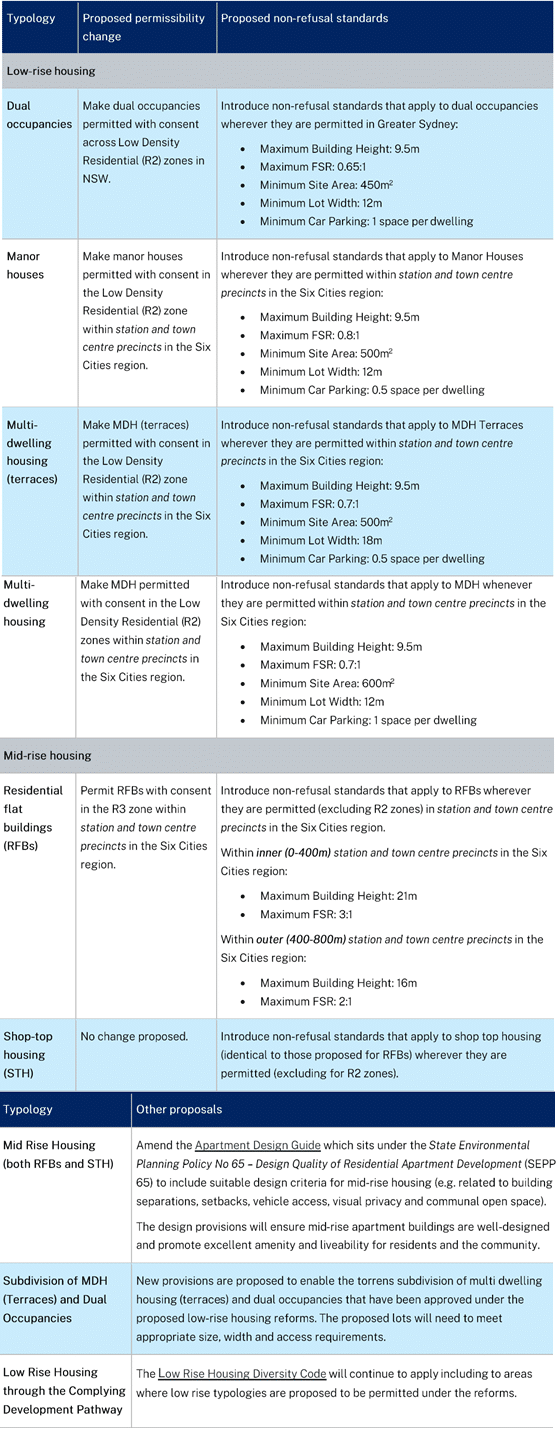
Lastly, these are the summary tables provided:
Below are summary tables of what is proposed for Dual Occupancies, Multi Dwelling Housing, Terraces, Manor Houses, Shop Top Housing and RFB’s, and there is also commentary around subdivision-
This is the link to the Low and Mid Rise Housing Code changes on exhibition: https://www.planningportal.nsw.gov.au/draftplans/exhibition/explanation-intended-effect-changes-create-low-and-mid-rise-housing
This is the link to the “Six Cities Discussion Paper”: https://greatercities.au/strategic-planning/region-plans/six-cities-region
Clients who have any questions in relation to this, please feel free to contact our office: 0460 000 000 or email planning@es.au